
Six ways to lock in private jet access in 2026, ranked by who genuinely benefits from a prepaid card and who is better off staying flexible. Best overall for flexibility: Private Flights' on-demand membership. Best for global fractional ownership: NetJets. Best budget entry point: Magellan Jets.
- The best jet card programs in 2026 trade fixed pricing for guaranteed availability, not automatically lower cost.
- Private Flights' on-demand membership wins for flyers under roughly 25 hours a year who want no lock-in.
- NetJets and Flexjet suit frequent flyers who want fractional ownership and wide fleet access.
- Magellan Jets is the lowest-commitment card entry point for occasional flyers testing the model.
- Sentient Jet's multi-operator network beats single-fleet cards on flexibility, not on guaranteed aircraft type.
Why this matters
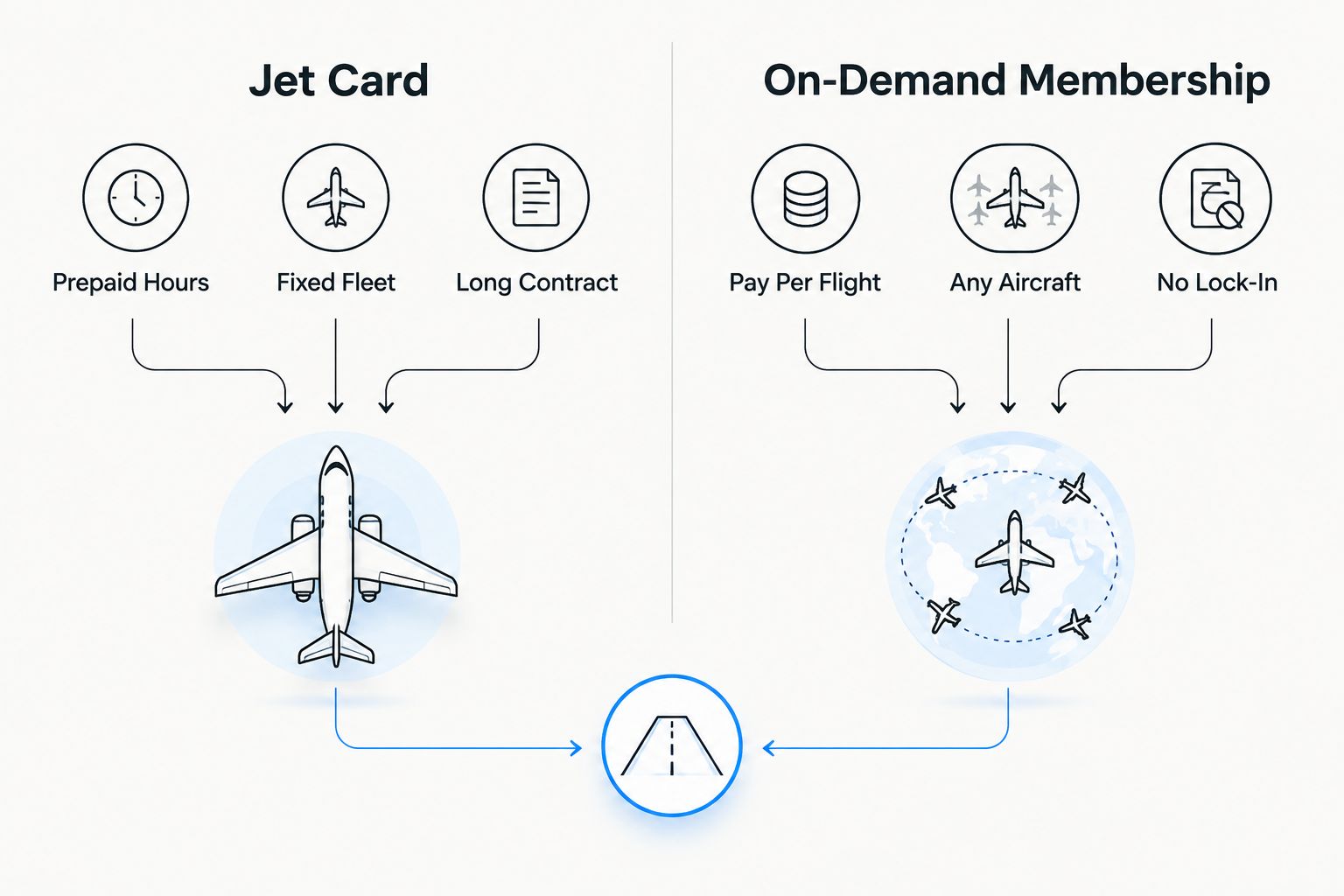
A jet card locks you into prepaid flight hours with one operator or network in exchange for a guaranteed rate and guaranteed availability. That trade only pays off if you actually fly enough to use the hours before the contract expires, and enough to offset the premium built into card pricing.
Private Flights works the other way: no prepaid balance, no fixed fleet, book charter or an empty leg per trip against a membership structure instead. For someone flying eight to ten times a year, that flexibility usually beats a card. For someone flying eighty hours a year, a card or fractional share starts to make more financial sense. This guide ranks both camps against each other so you know which one you actually are before you sign anything in 2026.
What makes the best jet card programme
- Guaranteed availability window — how much notice the programme commits to on peak days, not just off-peak.
- Fleet depth — access across light, midsize, super-mid and heavy categories, not just one cabin size.
- Minimum commitment — entry-level hour blocks and contract length before you're locked in.
- Peak-day surcharges and blackout dates — the fine print that erodes the "guaranteed rate" pitch.
- Operator network and safety audit standard — single-fleet ownership versus a multi-operator network audited to ARGUS or Wyvern.
- Interchange flexibility — whether you can swap aircraft category mid-contract without penalty.
Best jet card programs in 2026: at a glance
| Programme | Best for | Standout feature | Key limitation |
|---|---|---|---|
| Private Flights Membership | Flexible, no-lock-in access | Book any operator's aircraft on demand plus empty legs | No fixed hourly rate locked months ahead |
| NetJets | Fractional ownership at global scale | Owns and operates most of its own fleet | High minimum spend, multi-year contracts |
| Flexjet | Heavy-jet, long-range flying | Consistent access to super-mid and heavy cabins | Best value only at higher annual usage |
| Sentient Jet | Multi-operator flexibility | ARGUS-audited network across many operators | Aircraft type varies flight to flight |
| Magellan Jets | Lowest-commitment card entry | Smaller minimum hour blocks than major fractional players | Narrower aircraft category at entry tier |
| Wheels Up | Short-haul domestic frequency | Dense regional network for quick hops | Limited relevance outside the US market |
1. Private Flights Membership: best jet card alternative for flexible, no-lock-in access
Private Flights books private jet charter on demand, arranges empty leg deals, and runs membership programmes for travellers who want repeat access without owning a card balance. Every trip is quoted against the current charter market rather than a pre-agreed multi-year rate, and operators are vetted against ARGUS safety ratings before a booking is confirmed.
Private Flights pros:
- No prepaid hour balance sitting on a card that expires
- Access to whichever aircraft category actually suits the route, not one fixed fleet
- Empty leg deals lower cost on repositioning flights
- Membership structure without a multi-year contract
Private Flights cons:
- No fixed hourly rate guaranteed months in advance
- No fractional equity or ownership stake in an aircraft
- Availability is confirmed per trip, not contractually locked a year out
Best for: flyers doing fewer than roughly 25 hours a year who want charter or membership access without a jet card's prepaid structure.
Verdict: Recommended for occasional-to-moderate flyers; move to a card only once usage climbs well past that threshold.
2. NetJets: best fractional ownership programme for global frequent flyers
NetJets is the largest fractional ownership operator in the industry, running both jet card tiers and fractional share ownership across an owned fleet rather than subcontracting flights out. Its scale gives it infrastructure few competitors match.
NetJets pros:
- Owns and operates most of its own fleet instead of relying on third-party lift
- Established global operations and crew base
- Consistent cabin standard across its owned aircraft
NetJets cons:
- Large minimum spend and multi-year contract structures
- Fractional shares carry depreciation and ongoing management fees
- Premium pricing versus broker-arranged charter for occasional flyers
Best for: frequent flyers with enough annual hours to justify an ownership-style commitment.
Verdict: Consider only above high annual usage; skip if you fly occasionally.
3. Flexjet: best for heavy-jet and long-range membership flying
Flexjet's fractional and jet card programme leans into larger cabin categories, giving members consistent access to super-mid and heavy jets for long-range and international routing rather than short domestic hops.
Flexjet pros:
- Access to super-mid and heavy cabin categories
- Consistent aircraft and crew experience across multi-leg trips
- Suited to international and transatlantic routing
Flexjet cons:
- Value skews toward higher-usage, long-range flyers
- Smaller footprint on short domestic sectors
- Entry commitment still substantial versus card-only programmes
Best for: long-range or international flyers who regularly need bigger cabins.
Verdict: Recommended for heavy long-haul users; skip for short-hop domestic flying.
4. Sentient Jet: best for multi-operator flexibility
Sentient Jet runs an asset-light jet card model, sourcing aircraft from an audited network of operators instead of owning its own fleet. It's one of the longest-running card programmes in the US market, built around flexibility rather than a fixed tail number.
Sentient Jet pros:
- Broad, ARGUS-audited operator network
- Flexible aircraft category swaps trip to trip
- No single-fleet dependency if one operator has availability issues
Sentient Jet cons:
- Aircraft type and interior vary flight to flight
- No equity or ownership stake
- Less consistent cabin experience than a single-fleet card
Best for: card buyers who value variety across aircraft types over consistency.
Verdict: Good fit for variety seekers; skip if you want the same cabin every trip.
5. Magellan Jets: best budget entry-level jet card
Magellan Jets positions itself as an accessible way into the jet card model, offering smaller minimum hour blocks than the major fractional players so newer buyers can test the format before committing further.
Magellan Jets pros:
- Lower entry commitment than major fractional programmes
- Flexible tier options for smaller annual usage
- Transparent card structure for first-time buyers
Magellan Jets cons:
- Smaller aircraft category options at the entry tier
- Less global reach than NetJets or Flexjet
- Narrower availability guarantees than larger programmes
Best for: occasional flyers testing the jet card model before scaling up.
Verdict: Good starter option; skip once usage passes roughly 100 hours a year, where larger programmes earn their premium.
6. Wheels Up: best for short-haul frequent domestic flying
Wheels Up runs a US-focused membership and card programme built around smaller cabin categories such as King Air and Citation aircraft, aimed at dense regional networks rather than long-haul routing.
Wheels Up pros:
- Strong domestic US network density
- Quick booking turnaround for short regional hops
- Membership tiers that scale with usage
Wheels Up cons:
- Limited relevance for European or transatlantic flyers
- Smaller cabin categories limit long-haul comfort
- Less useful outside the US regional market
Best for: US-based flyers doing frequent short regional trips.
Verdict: Skip for European or long-haul flying; fine for US regional use.
“A jet card only pays off if you fly enough hours to beat the guaranteed-availability premium baked into the rate.”
How this ranking was built
Each programme was measured against the same six criteria above: guaranteed availability, fleet depth, minimum commitment, peak-day surcharges, safety audit standard, and interchange flexibility. Programmes that lock buyers into large minimums without matching fleet depth or flexibility lose ground here even when their brand recognition is strong.
Compare charter against a card first
See what on-demand access costs before signing a multi-year jet card contract.
Which jet card programme should you choose in 2026?
If you fly fewer than roughly 25 hours a year, start with an on-demand membership like Private Flights before locking into a prepaid card — you keep access to any aircraft category without carrying a balance that expires. Past that usage level, NetJets or Flexjet start earning their premium through guaranteed fleet access and consistent cabin standards. Magellan Jets remains the sensible middle ground for testing the model without the largest programmes' contract size.
FAQ
What is a jet card programme?
A jet card is a prepaid block of flight hours purchased with one operator or network in exchange for a fixed rate and guaranteed availability. It differs from on-demand charter, which is booked and priced per trip.
Is NetJets better than Flexjet in 2026?
NetJets wins on fleet ownership and global scale; Flexjet wins on consistent access to super-mid and heavy cabins for long-range flying. The better choice depends on route length and annual hours, not brand alone.
How much does a jet card cost in 2026?
Jet card pricing is quoted per flight hour plus fixed fees that vary by aircraft category and provider. Check current rates directly with each programme rather than relying on published averages, since they change through the year.
What's the minimum commitment for a jet card?
Many jet card programmes set an entry-level minimum around 25 flight hours, though smaller-tier programmes like Magellan Jets offer reduced blocks for occasional flyers. Larger fractional programmes typically require more.
Is a jet card cheaper than chartering on demand?
Not automatically. A card locks in a rate and guaranteed availability, which carries a premium; on-demand charter through a broker like Private Flights prices each trip against the current market and can be cheaper for occasional flyers.
Can you use a jet card in Europe?
Some US-based programmes like Wheels Up are built around domestic regional networks and offer limited European relevance. Programmes such as NetJets, Flexjet and Sentient Jet, along with on-demand European charter brokers, cover transatlantic and intra-European routing more directly.
What's the difference between a jet card and fractional ownership?
A jet card is a prepaid hours contract with no ownership stake, while fractional ownership buys equity in a specific aircraft alongside management fees. NetJets and Flexjet both offer fractional shares in addition to card tiers.
Is Private Flights' membership a jet card?
No. Private Flights' membership programme books charter and empty legs on demand rather than prepaying a fixed hour balance, which makes it better suited to flyers who fly under roughly 25 hours a year.
One last thing
Most buyers compare jet card headline rates and miss the peak-day surcharge clause entirely — the exact window (major holidays, big sporting weekends) is where a "guaranteed rate" card quietly costs more than an on-demand quote booked the same week. Read that clause before comparing anything else in 2026.